

After a fall, it can be very difficult to tell a sprained wrist from a broken one. A sprain is an injury to the ligaments; a fracture is a break in one or more bones. Both can cause pain, swelling, bruising and difficulty moving the wrist, and how much it hurts does not reliably separate them. An examination and an X-ray are usually needed to confirm what has been injured.
At a glance
A sprain injures ligaments. A fracture is a broken bone. "Fracture" and "broken bone" mean the same thing.
Pain, swelling, bruising and tenderness can occur with either injury, so symptoms overlap.
Being able to move your wrist does not rule out a fracture, and a fracture does not always look crooked.
Deformity, numbness, pale or cold fingers, an open wound or severe pain after major trauma need urgent assessment.
What Happens to the Wrist During a Fall?
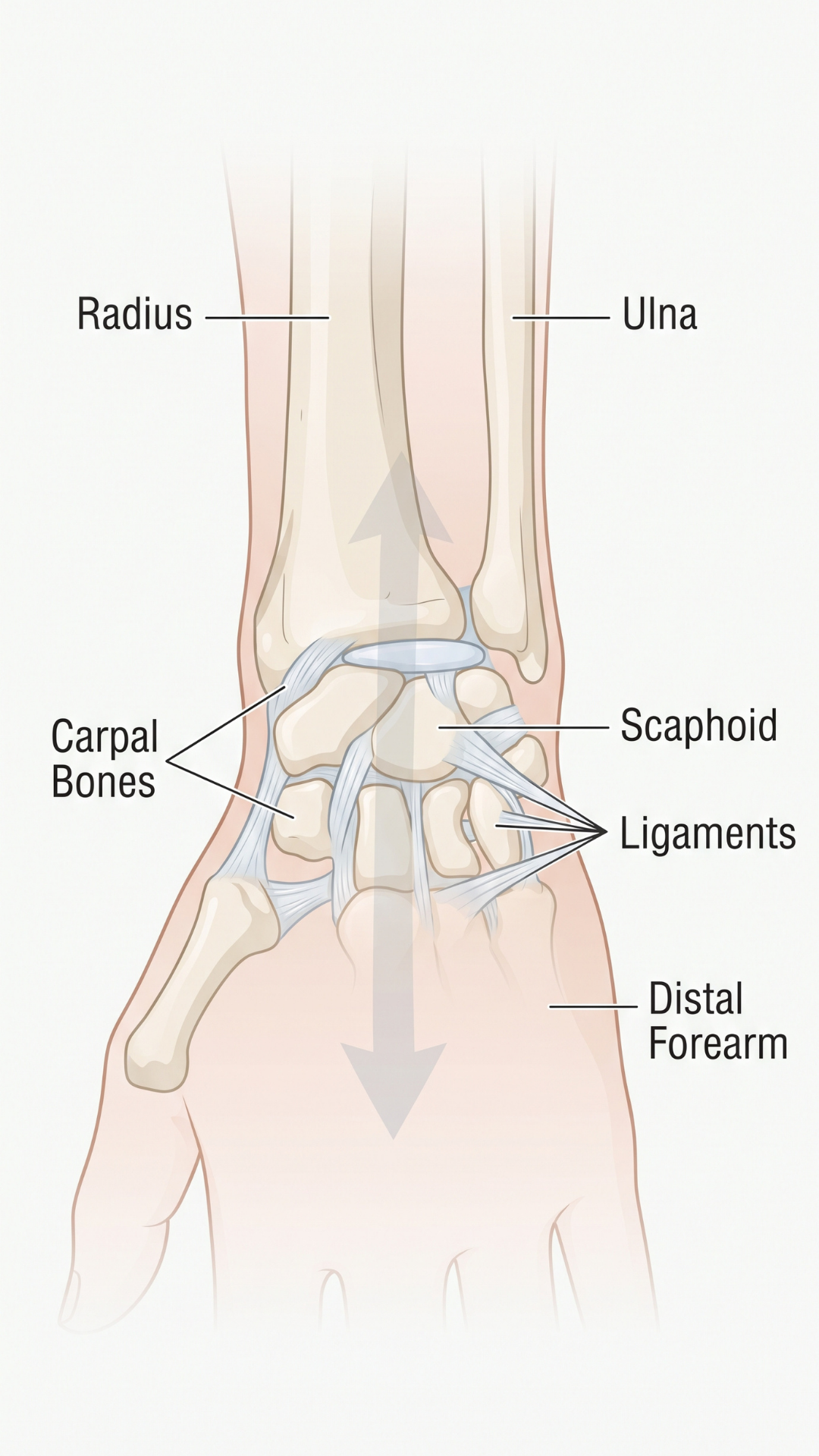
Most wrist injuries from a fall happen the same way: you put a hand out to protect yourself, and your body weight travels through the palm into the wrist. Clinicians call this a fall on an outstretched hand.
That force has to go somewhere. It may stretch or tear the ligaments that hold the small wrist bones together, break one of the bones, or do both at the same time.
The radius — the larger forearm bone on the thumb side — is the bone most commonly broken in this way, and these are the injuries covered on our page about wrist wrist fractures. The small carpal bones, particularly the scaphoid near the base of the thumb, can also be injured; these are described in more detail under the scaphoid and other carpal bones
The same fall, at a slightly different angle or speed, can produce a mild ligament sprain in one person and a broken bone in another. That is why the injury story alone cannot tell you what has happened inside the wrist.
What Is the Difference Between a Wrist Sprain and a Fracture?
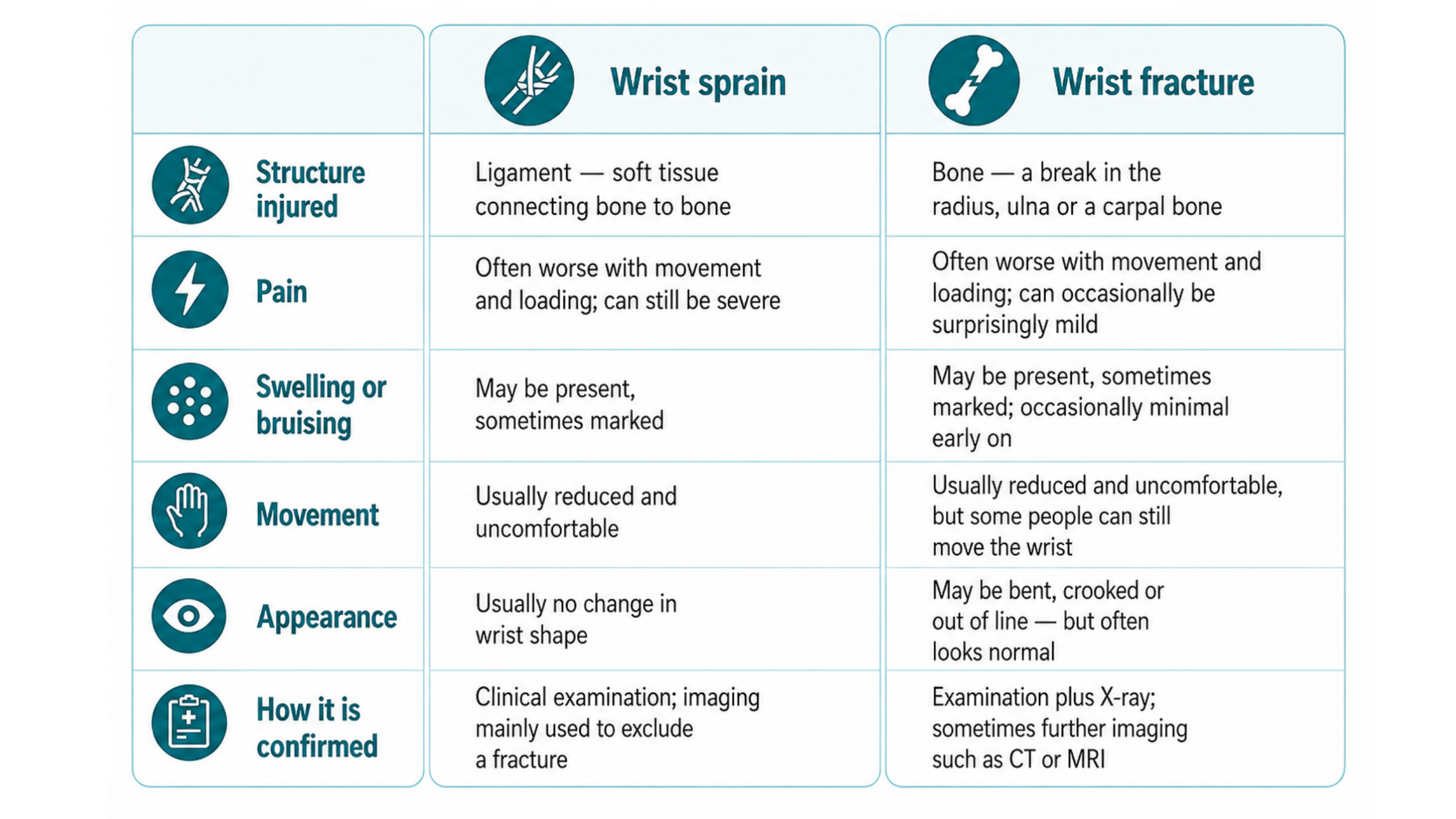
A sprain is an injury to a ligament — the tough bands of tissue that connect bone to bone and stabilise the joint. The ligament may be stretched or partly or completely torn.
A fracture is a break in a bone. "Fracture" and "broken bone" mean exactly the same thing; one is not more serious than the other simply because of the word used.
The two injuries can occur together. It is entirely possible to break a bone and injure the surrounding ligaments in the same fall.
Signs That May Suggest a Wrist Sprain
Some features are more often seen with a ligament injury, although none of them proves that a bone is intact.
Pain that is more spread out across the wrist rather than concentrated at one small point
Tenderness over the soft tissues rather than directly over a bone
Swelling that develops gradually over hours rather than immediately
A wrist that looks normal in shape
Discomfort that eases noticeably with rest, support and a day or two of protection
Sprains are graded by how badly the ligament is stretched or torn, and a bad sprain can be genuinely painful and slow to settle. If you want to read more about ligament injuries and wrist pain that lingers, see wrist sprains and ongoing wrist pain
The key point is that these features make a sprain more likely, not certain. Assume a sprain only after a fracture has been reasonably excluded — not instead of having it checked.
Signs That May Raise Concern About a Wrist Fracture
Certain features make a broken bone more of a concern and are worth taking seriously:
Point tenderness over bone — pain that is sharply localised when one specific spot is pressed, rather than generally sore
Tenderness on the thumb side of the wrist, in the small hollow at the base of the thumb, which may be associated with a scaphoid injury
Marked or rapidly developing swelling
A change in the shape of the wrist — bent, crooked or sitting at an odd angle
Pain on gripping, pinching, pushing or taking weight through the hand
Pain that does not settle at all over the first day or two
A significant mechanism — a fall from height, a sporting collision, a road accident, or a fall in someone with thinning bones
Tenderness at the base of the thumb is a clinically useful observation, but it is not a home diagnostic test. Pressing on your own wrist to "check" is unreliable and can be uncomfortable without telling you anything definite.
Can You Still Move Your Wrist If It Is Broken?
Yes. Many people with a broken wrist can still move it, and some can still use the hand for light tasks. Movement is often reduced and painful, but the ability to move your wrist or fingers does not rule out a fracture. Using the phrase "I can still move it, so it can't be broken" is one of the most common reasons an injury is left unchecked.
Can a Fracture Occur Without Obvious Swelling or Deformity?
Yes. A fracture can be present with modest swelling and a wrist that looks completely normal. Undisplaced fractures — where the bone is cracked but the pieces have not shifted — may cause surprisingly little visible change. Some wrist-bone fractures, particularly of the scaphoid, are subtle enough that they are not visible on the first X-ray and only become apparent on later or more detailed imaging.
Why Symptoms Alone Cannot Confirm the Diagnosis
Because the two injuries share the same symptoms, self-assessment is unreliable.
Pain severity is a poor guide. A torn ligament can be excruciating, while an undisplaced fracture can feel like a bad bruise. Neither the loudest pain nor the mildest pain tells you which tissue is damaged.
Swelling is also a poor guide. It reflects how much bleeding and inflammation the injury has produced, not whether a bone is broken.
Even experienced clinicians do not rely on examination alone. They combine what happened, what the wrist looks like, where it is tender and how it moves, and then use imaging to confirm. This is why guidance for wrist injuries consistently points towards examination plus an X-ray rather than a symptom checklist.
There is one further reason for caution: a normal first X-ray does not always exclude every wrist fracture. Some fractures — the scaphoid being the classic example — may not be visible for days. When suspicion remains high, a clinician may arrange repeat X-rays or more sensitive imaging such as MRI or CT.
How Is a Painful Wrist Assessed After a Fall?
Assessment after a fall is usually straightforward and follows a predictable sequence.
The injury history. How you fell, what the hand was doing at the time, how much force was involved, what you felt immediately, and what you have and have not been able to do since.
Examination of the wrist. Looking for swelling, bruising and any change in shape, then gently identifying exactly where the tenderness is — which is often the most informative part of the examination.
Checking circulation, sensation and movement. Colour and warmth of the fingers, sensation in the thumb, fingers and hand, and how well the fingers and wrist move. This matters because swelling or a displaced fracture can occasionally press on nerves or restrict blood flow.
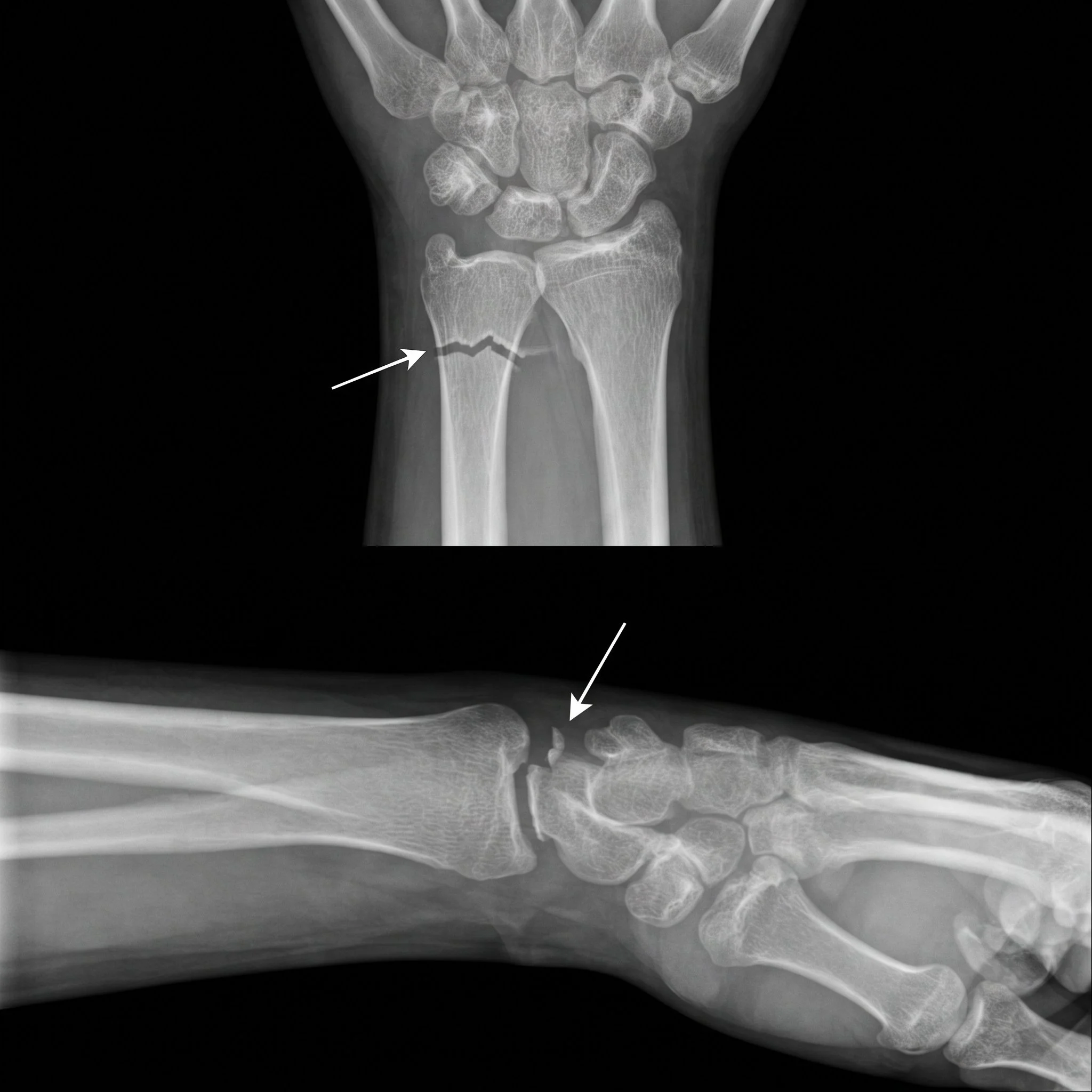
X-rays. Standard imaging shows most fractures and whether the bone fragments have shifted out of position.
Further or repeat imaging where indicated. If the X-ray is normal but the examination still points strongly towards a fracture, a clinician may recommend a repeat X-ray after an interval, or CT or MRI. In the UK, national guidance suggests considering MRI as a first-line investigation for a suspected scaphoid fracture after thorough clinical examination — a reminder that a normal initial X-ray is not always the end of the story.
If imaging does confirm a break, the next questions — which bone, whether it has moved, and what treatment that calls for — are covered in detail under how wrist fractures are diagnosed and treated.
What Should You Do While Waiting to Be Assessed?
Keep it simple in the meantime:
Stop using the wrist for lifting, pushing or gripping
Support it in a comfortable position, for example in a sling or resting on a cushion
Remove rings, bracelets and watches early, before swelling makes them difficult to take off
Use sensible short-term measures for pain and swelling, and avoid testing the wrist to see how bad it is
Repeatedly moving or loading the wrist to check whether it "still works" is not a useful test and may make things sorer.
For step-by-step first aid in the first day or two, see how to use the RICE method after a wrist injury
When Should You Seek Urgent Medical Attention?
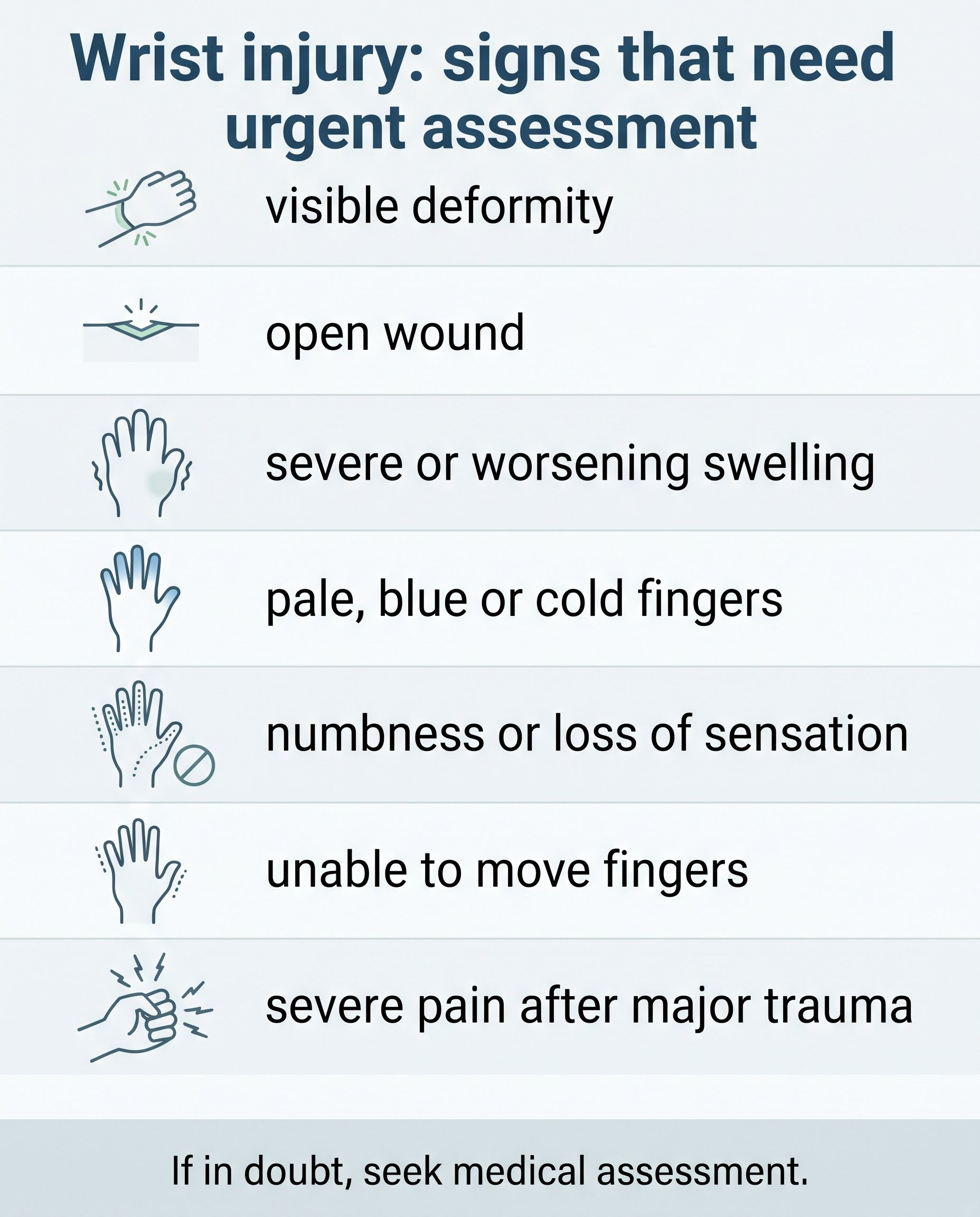
Go to an emergency department, or seek immediate medical help, if any of the following apply:
The wrist or forearm looks bent, crooked or out of shape
There is an open wound over the injury, or bone is visible
Swelling is severe or worsening quickly
The fingers become pale, blue, grey or cold
There is numbness, pins and needles, or loss of sensation in the hand or fingers
You cannot move your fingers
The pain is severe, or the injury followed substantial trauma such as a fall from height or a road accident
Dr Lee attends emergency hand and wrist cases at several private hospitals in Singapore — see emergency hand and wrist care
This is different from arranging a routine appointment. If none of the above applies but your wrist remains painful, swollen or difficult to use after a day or two, that is a reason to arrange a non-emergency assessment rather than to attend A&E.
Getting Your Wrist Properly Assessed
If you are unsure whether your wrist is sprained or broken, that uncertainty is itself a reasonable reason to have it looked at. The purpose of an assessment is to find out what has actually been injured — not to commit you to any particular treatment.
Being assessed does not mean you will need surgery. Many wrist injuries after a fall turn out to be soft-tissue injuries that settle with protection and time. Many fractures are treated without an operation, in a cast or splint. Surgery is considered for some fractures, depending on which bone is broken, whether the fragments have shifted, whether the joint surface is involved, the quality of the bone, and what you need your hand to do.
Knowing which of these applies to you is the point of getting it checked. Guessing is not a treatment plan. If you are weighing up whether a GP visit is enough or whether to see a specialist, it may help to read what a hand surgeon assesses
Frequently Asked Questions
-
If pain, swelling or difficulty using the wrist has not clearly improved within a day or two, it is reasonable to arrange an assessment. Pain that persists beyond that point is one of the recognised reasons to consider imaging. You do not need to wait weeks. Any of the urgent warning signs listed above warrant immediate attention rather than waiting. If your wrist has been sore for some time already, see wrist sprains and chronic wrist pain
-
DeNo. Swelling is common but not universal, and its extent does not reliably indicate how serious the injury is. An undisplaced fracture — where the bone is cracked but has not shifted — may produce only modest swelling. Some people notice more stiffness and pain on gripping than visible swelling. A wrist that looks unremarkable can still be fractured.scription text goes here
-
Yes. A significant ligament tear can be extremely painful, sometimes more so in the first hours than a small undisplaced fracture. Pain intensity reflects tissue injury, bleeding and inflammation rather than which tissue is damaged. This is one of the main reasons that pain alone cannot be used to tell a sprain and a fracture apart.
-
No. Visible deformity — a wrist that is bent or sitting at an odd angle — raises real concern about a fracture or dislocation and needs urgent attention. However, its absence rules nothing out. Fractures in which the bone fragments have stayed in position often leave the wrist looking entirely normal from the outside.
-
Not always. Whether imaging is needed depends on how the injury happened, the findings on examination and how the wrist behaves over the first day or two. A clinician makes that judgement. It is also worth knowing that a normal first X-ray does not always exclude every fracture, and repeat or more detailed imaging is sometimes recommended when suspicion remains.