

If you've fallen and hurt your wrist, RICE — Rest, Ice, Compression and Elevation — is a simple first-aid approach that may help manage pain and swelling in the early stages.
It's not a diagnosis, and it won't tell you whether your wrist is sprained, fractured or otherwise injured. This guide explains how to use each part of RICE safely, what to avoid, and the signs that mean it's time to see a doctor rather than rely on first aid alone.
What Is the RICE Method?
RICE stands for Rest, Ice, Compression and Elevation. It is a well-known first-aid approach for minor soft-tissue injuries such as sprains and strains, aimed at limiting swelling and easing discomfort in the early stages after an injury.
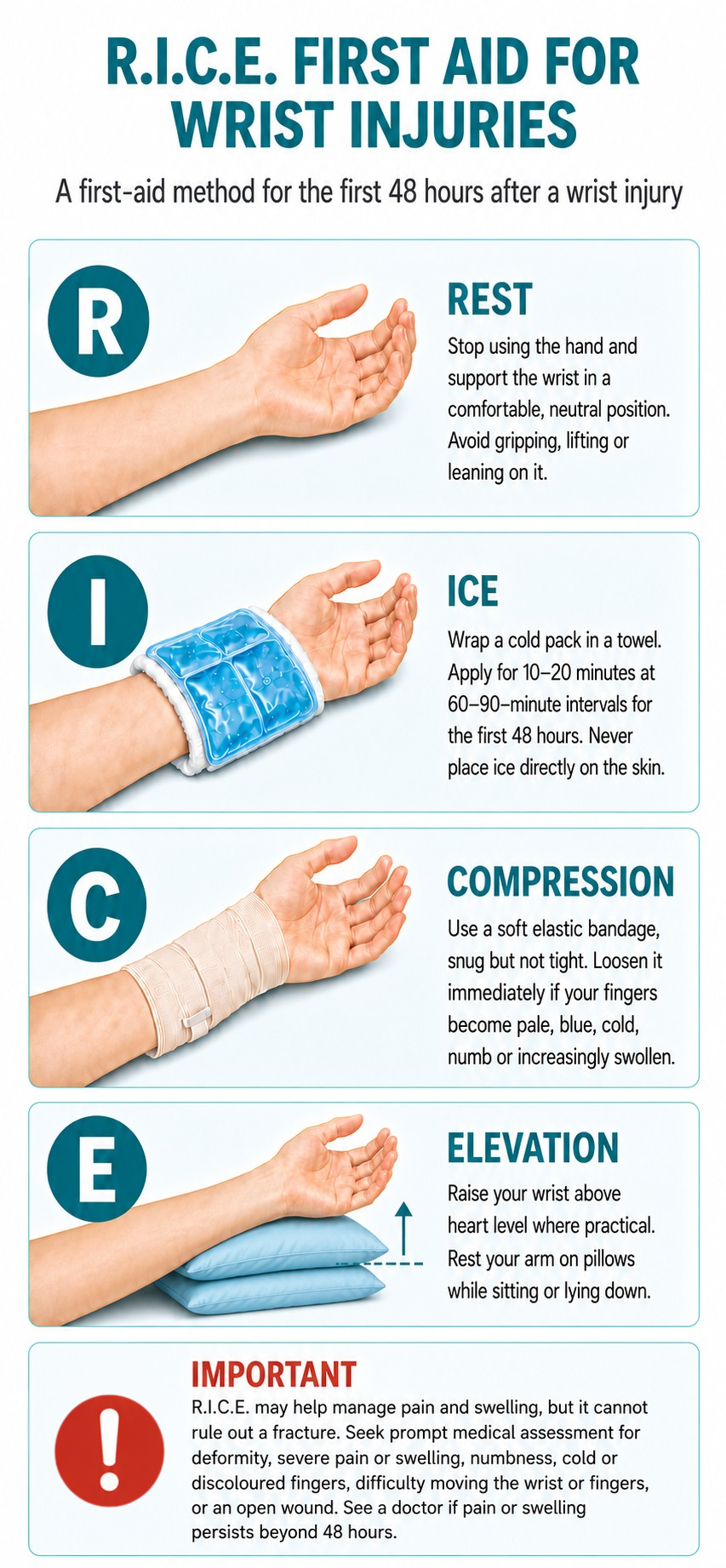
RICE does not treat the underlying injury. It is best thought of as a way to make yourself more comfortable and avoid making things worse while you decide whether — and how soon — you need to be seen by a doctor.
When RICE May Help
RICE may be a reasonable first step if, after a fall, your wrist is painful, mildly swollen or tender, but you can still move your fingers, there is no visible deformity, and the pain is manageable. This pattern is often seen with minor soft-tissue injuries, though it does not rule out a fracture.
What RICE Cannot Do
RICE will not tell you whether a bone is broken. Not every painful wrist after a fall is simply a sprain, and some fractures are not obvious in the first hours after injury. If you're at all unsure how serious the injury is, use RICE as a short-term measure while arranging a medical assessment — not as a reason to delay one.
It's also worth knowing that medical thinking on early injury care has moved on in recent years. Older advice favoured strict rest and generous icing, but current guidance places more emphasis on protecting the injury briefly, avoiding prolonged rest, and reintroducing gentle movement once a more serious injury has been excluded. RICE remains a reasonable and low-risk starting point, but it isn't the final word on recovery.
Immediate Steps After Falling on Your Wrist
Before starting RICE, take a moment to check the injury:
Stop using the hand and avoid putting weight through it.
Remove any rings, bracelets or watches from that hand or wrist in case of swelling.
Check that you can move your fingers and that they have normal colour and sensation.
If there is significant pain, visible deformity, or you cannot move your fingers, seek medical attention rather than starting first aid at home.
If none of these apply, you can begin RICE while you decide on next steps.
How to Rest and Protect Your Wrist
Rest means avoiding movements and activities that load or twist the wrist, not necessarily staying completely still for days. Support the wrist in a comfortable, neutral position — a sling or simple support can help — and avoid gripping, lifting or leaning on the hand.
Brief protection in the first day or so is reasonable. Prolonged, complete rest is generally not recommended, as it can leave the wrist stiff and slow your recovery. If pain allows, gently moving the fingers and, once more comfortable, the wrist itself, can support healing. If a movement clearly increases pain, stop and avoid it rather than pushing through.
How to Ice Your Wrist Safely
Ice may help reduce pain and swelling in the first day or two after injury.
Wrap ice or a cold pack in a cloth or towel — never apply ice directly to the skin.
Ice the wrist for around 10 to 20 minutes at a time.
Leave at least 1 hour to 1.5 hours between icing sessions.
Stop icing if the skin becomes numb, unusually pale or painful.
Avoid icing for longer than recommended, as prolonged or very cold exposure can damage the skin. Icing is a comfort measure rather than a treatment that changes how quickly the injury heals, and current evidence on how much benefit it provides is more limited than commonly assumed.
How to Apply Compression Without Impairing Circulation
A compression bandage can help limit swelling, but it must be applied carefully.
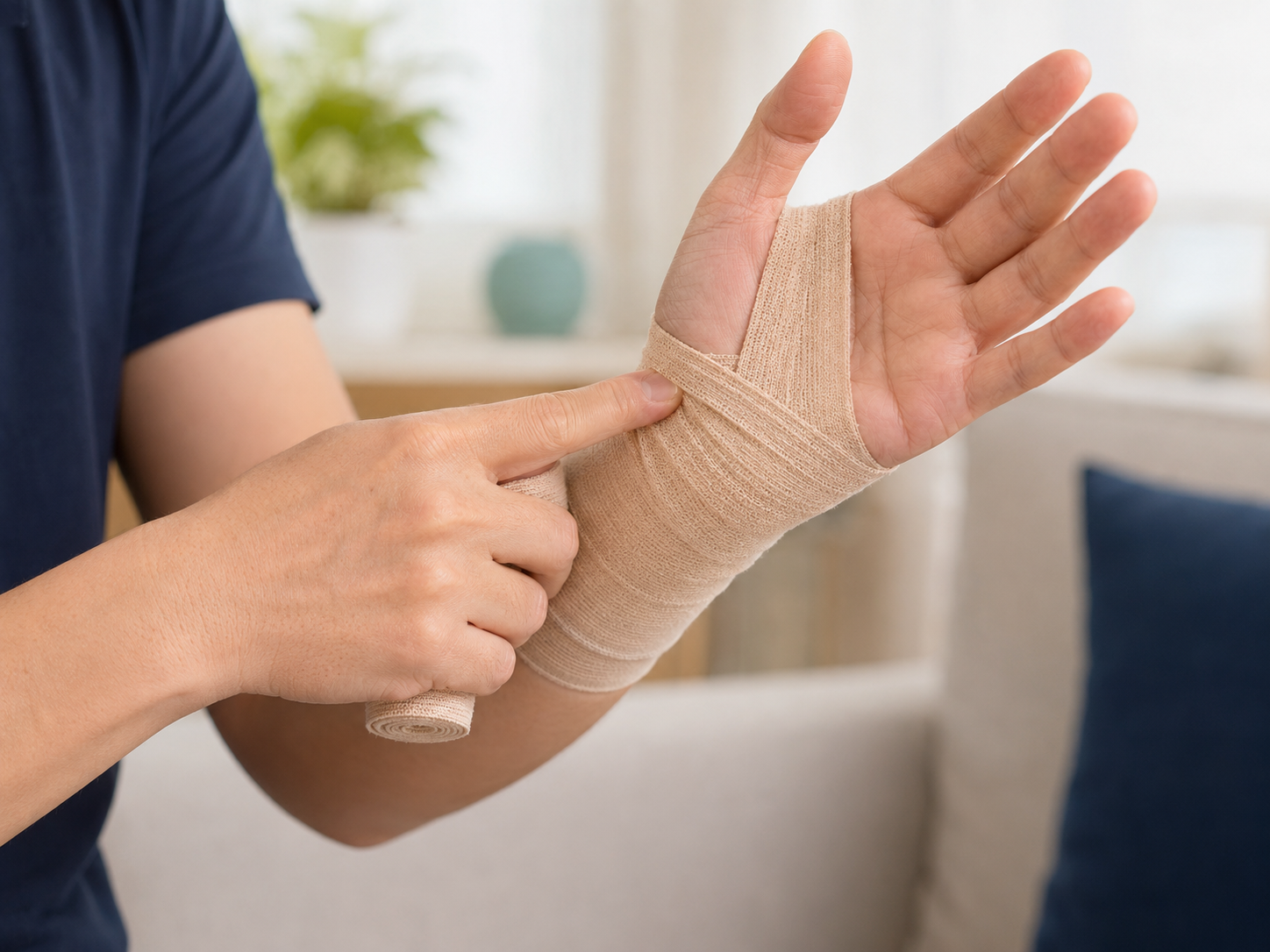
Use a soft, elastic bandage wrapped snugly, not tightly, around the wrist.
You should be able to fit a finger comfortably under the bandage.
Check your fingers regularly for colour, warmth, sensation and any tingling or numbness.
Loosen the bandage immediately if your fingers become pale, blue, cold, numb or increasingly swollen.
A bandage that is too tight can restrict blood flow, which is a genuine safety risk. If you're unsure how firmly to wrap it, err on the side of looser support and seek medical advice.
How to Elevate Your Wrist
Raising the wrist above the level of your heart, where practical, can help reduce swelling. Resting your arm on a cushion or pillow while sitting or lying down is a simple way to do this, particularly in the first day after the injury.
Warning Signs That Need Prompt Medical Assessment
RICE is only appropriate for minor injuries. Seek medical assessment promptly if you notice any of the following:
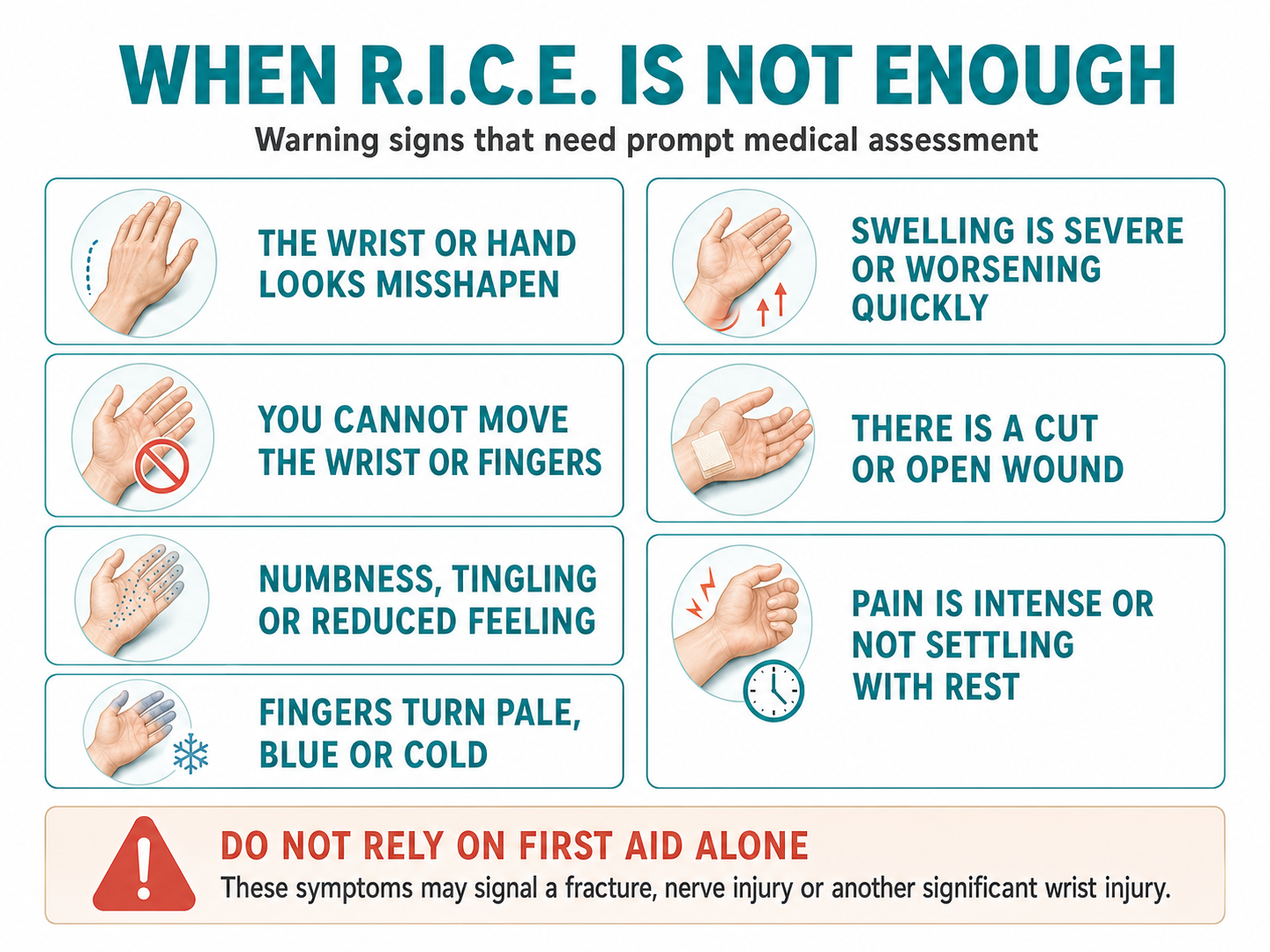
Visible deformity of the wrist or hand
Inability to move your fingers or wrist
Numbness, tingling or persistent loss of sensation
Fingers that appear pale, blue or feel cold
Severe or rapidly increasing swelling
An open wound at the injury site
Pain that is severe or does not start to ease with rest
These signs may indicate a fracture, nerve involvement or a more significant injury than a simple sprain, and first aid alone is not appropriate in these situations.
What to Do if Pain or Swelling Does Not Improve
If your symptoms have not started to settle after a day or two of RICE, or if pain, swelling or stiffness are getting worse rather than better, this is a reasonable point to arrange a medical assessment. First aid is meant to help in the short term — it is not a substitute for finding out what caused the injury in the first place.
Getting Assessed
Dr. Jonathan Lee Yi-Liang is the founder and medical director of the Singapore Hand & Reconstructive Microsurgery Clinic, an accredited specialist in hand and reconstructive microsurgery.
If your wrist pain persists, worsens, or you're unsure whether first aid is enough, you can contact the clinic for an assessment at +65 6836 8382 or WhatsApp +65 9451 5807.
Our clinic works with major insurers, including AIA, Prudential, Great Eastern, NTUC Income and HSBC, among others. If you're wondering about coverage, feel free to ask our clinic team when you book — they can guide you on the information or documents that may help you check what your policy covers, which will depend on your individual policy, diagnosis and the treatment involved.